washington Capitol Building 2025
|
I am writing to provide NACDS chain members with an assessment of Tuesday’s historic elections and their implications for our pro-patient, pro-pharmacy, and pro-business priorities. This year’s results reshaped the landscape at both the federal and state levels.
- At the federal level, our focus is on the new Congressional leadership, the opportunities and challenges facing pharmacy during the remaining weeks of the 119th Congress, and the policy environment we anticipate in the 120th Congress.
- At the state level, the elections reset the policymaking environment heading into 2027, producing new governors, new legislative majorities, and a new generation of policymakers who will shape pharmacy policy in the states for years to come.
Democrats achieved sweeping victories at the federal level, capturing control of both the House and Senate and winning races in states and districts that have historically favored Republicans. The results will fundamentally change the balance of power in Washington. However, with Republicans retaining control of the White House and the Senate filibuster remaining an obstacle to most legislation, bipartisan cooperation will still be necessary to enact major healthcare policies. At the state level, the elections produced significant turnover in governorships and legislative chambers, with shifts in party control and trifecta status that will redraw the map for our 2027 state advocacy strategy.
Election results remain preliminary, with additional races yet to be called at both the federal and state levels.
PART ONE: FEDERAL — THE 2026 CONGRESSIONAL ELECTIONS
Congressional Election Results and Leadership
U.S. Senate
-
- Democrats have secured the Senate majority, flipping at least seven Republican-held seats, including historic victories in Texas, Kansas, South Carolina, and Iowa. Kansas elected its first Democratic Senator since 1932, while South Carolina elected its first since 1998. The results represent one of the most significant Senate shifts against a president’s party in recent decades.
- Sen. Chuck Schumer (D-NY) is expected to become Senate Majority Leader, while Sen. John Thune (R-SD) is expected to remain the top Senate Republican, serving as Minority Leader. Senate Republicans have scheduled leadership elections for November 10.
- The election results will give Democrats control of the Senate’s legislative agenda, committee chairmanships, and consideration of Presidential nominees. However, Republicans will retain substantial leverage through the legislative filibuster.
U.S. House of Representatives
-
- Democrats have captured the House majority, flipping more than two dozen Republican-held districts, including victories in traditionally Republican territory. Several additional races remain outstanding.
- Rep. Hakeem Jeffries (D-NY) is expected to become Speaker of the House. Rep. Katherine Clark (D-MA) is expected to become Majority Leader, with Rep. Pete Aguilar (D-CA) positioned to become Majority Whip.
- House Republican leadership is considerably less certain. Speaker Mike Johnson (R-LA) has indicated that he will not seek the role of House Minority Leader. Current Majority Leader Steve Scalise (R-LA) and Rep. Jim Jordan (R-OH) are potential candidates for that role. The extent of Republican losses could influence whether members seek continuity or new leadership. Current Majority Whip Tom Emmer (R-MN) has indicated his intention to seek the minority whip position.
- House Republicans are scheduled to hold leadership elections on November 10, providing an early indication of how the party intends to respond to its electoral losses.
Changes to Key Congressional Committees
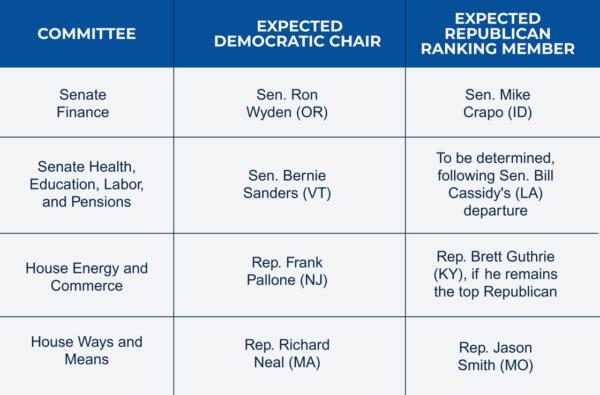
Democratic control of Congress will produce changes in leadership roles across the four committees with primary jurisdiction over NACDS’ federal healthcare priorities.
election-1
-
- Senate Finance: Sens. Wyden and Crapo have longstanding relationships with NACDS and were instrumental in advancing the Medicare Part D PBM reforms enacted earlier this year. Their continued leadership offers important continuity, although committee membership will change substantially. Notably, six of the 14 current Republican members of the committee will be departing, creating significant opportunities to establish relationships with incoming members.
- Senate Health, Education, Labor, and Pensions: Sen. Sanders is expected to return as chairman. With Sen. Cassidy’s departure, Republicans will need to select a new ranking member, creating a potentially consequential leadership change for pharmacy and broader healthcare policy. Six of the committee’s 12 current Republican members will be departing, representing turnover of half the Republican membership.
- House Energy and Commerce: Rep. Pallone is expected to return as chairman, while Rep. Guthrie is positioned to become ranking member. Both have extensive histories of engagement with NACDS and its priorities, including PBM reform and pharmacist services.
- House Ways and Means: Reps. Neal and Smith are expected to exchange leadership positions. The committee’s bipartisan approval of the Main Street Pharmacy Access Act/ECAPS earlier this year provides a valuable foundation for continued advocacy.
Significant Congressional Turnover Creates New Advocacy Opportunities
The election will bring one of the largest influxes of new lawmakers in recent decades, reflecting retirements, decisions to seek other offices, primary defeats, and Tuesday’s election results.
-
- Senate: At least 20 Senators will be new to the chamber in January, including replacements for 13 open Senate seats and at least seven Republican-held seats captured by Democrats. This figure includes returning former Sen. Sherrod Brown (D-OH), who defeated Sen. Jon Husted (R-OH) just two years after losing his reelection bid and has a longstanding record of supporting pharmacy priorities, including PBM reform. Two additional Senate races remain undecided in Alaska and Mississippi, where incumbent Republicans are facing competitive Democratic challengers. The final number of new Senators could therefore increase.
- House: At least 75 House seats were open heading into the election, the second-highest number in approximately 50 years. Combined with Democratic victories over Republican incumbents and other election defeats, the incoming House freshman class is expected to exceed 100 members, representing nearly one-quarter of the chamber. The final total will depend on outstanding races.
- Committee membership: Turnover will be particularly significant on the Republican side of the Senate Finance Committee and the Health, Education, Labor, and Pensions Committee, where six members of each panel are departing. In the House, election defeats, retirements, and changes in party ratios will also create opportunities for newly elected members to join the Energy and Commerce and Ways and Means Committees.
NACDS will prioritize early engagement with newly elected members of Congress and their staffs, beginning with Congressional orientation activities in November and continuing as the 120th Congress organizes in January. We will pay particular attention to incoming members who may seek assignments to the four committees of jurisdiction, while also building relationships with new lawmakers whose backgrounds and interests position them to become champions for pharmacy.
NACDS will work closely with member companies, Washington representatives, and NACDS RxIMPACT advocates to establish these relationships and educate new lawmakers about the importance of pharmacies to healthcare access, affordability, and their communities.
Mark your calendar now for the 2027 NACDS RxIMPACT Day on Capitol Hill, which will be held in Washington, D.C. at a new time of year: September 14-15, 2027. Registration information will be forthcoming.
Legislative Outlook: Lame-Duck Session and the 120th Congress
Remaining Weeks of the 119th Congress
-
- Republicans retain control of Congress through January 3, providing a final opportunity to advance legislative priorities before the transition to Democratic majorities.
- Some Republicans are considering one final budget reconciliation measure to advance priorities such as defense spending without overcoming a Senate filibuster. However, the election results and divisions within the Republican Conference raise significant questions about whether sufficient votes exist to pursue this approach.
- Democrats face a different calculation: whether to negotiate bipartisan legislation during the lame duck or defer certain issues until January, when their political position will improve dramatically. These decisions will influence the prospects for a broader year-end legislative package.
- The Main Street Pharmacy Access Act/ECAPS and Medicaid PBM reform remain NACDS’ leading legislative priorities for the lame-duck session. Following House Ways and Means Committee approval in May and a House Energy and Commerce Health Subcommittee hearing in September, the Main Street Pharmacy Access Act/ECAPS has achieved significant bipartisan momentum. NACDS and our coalition partners will continue pursuing opportunities for its inclusion in year-end legislation, recognizing that Congressional leaders have not yet determined the scope of any potential legislative package.
- Medicaid PBM reforms that were excluded from the legislation enacting historic Medicare Part D reforms earlier this year also remain a priority for year-end consideration. NACDS will continue working with industry partners and the committees of jurisdiction to advocate for their inclusion in any appropriate legislative vehicle.
Healthcare Policy in the 120th Congress
-
- Healthcare affordability is expected to be a major focus of the new Democratic majorities, including efforts to address Medicaid policy, Affordable Care Act coverage, prescription drug costs, and healthcare industry practices.
- An important indication of the Democratic agenda is the House Democratic Caucus Cost-of-Living Healthcare Working Group, co-chaired by Reps. Alexandria Ocasio-Cortez (D-NY) and Terri Sewell (D-AL). The working group’s proposals include priorities supported by NACDS, such as expanding access to pharmacist-provided services through the Main Street Pharmacy Access Act/ECAPS and strengthening PBM accountability.
- The working group’s recommendations also highlight an emerging debate about vertical integration in healthcare, particularly the concentration of insurers, PBMs, pharmacies, and other healthcare businesses within common corporate structures. This issue could become a significant focus of Congressional hearings, oversight, and legislation, with implications for competition, patient choice, and pharmacy access. That is expected to be the case, despite recent private-sector developments in this area.
- NACDS recently participated in a briefing with top health policy staff for Sen. Ron Wyden (D-OR), providing an early opportunity to discuss the Senate Finance Committee’s healthcare priorities for the remainder of the 119th Congress and the upcoming 120th Congress. The discussion, which included NACDS member-company Washington representatives, reinforced the importance of continued engagement with Sen. Wyden and his staff about PBM reform and other healthcare priorities as Democrats prepare to assume the committee chairmanship.
- While these developments suggest opportunities for NACDS priorities, they should not be viewed as a consensus Democratic legislative agenda. The new majority will need to reconcile competing policy perspectives, and significant legislation will continue to require bipartisan support and the President’s approval.
Other NACDS Priorities
-
- PBM Reform: NACDS will continue advocating for timely and faithful implementation of the historic Medicare Part D PBM reforms enacted this year, while pursuing additional reforms addressing harmful PBM practices, transparency, and vertical integration.
- 340B: Bipartisan proposals introduced during the 119th Congress include important protections for contract pharmacy participation. The new Congressional majorities could reshape the broader debate about 340B reform, including pharmacy protections, program oversight, and the Administration’s rebate model.
- TRICARE: NACDS will continue supporting the bipartisan Rx ACCESS Act and Congressional oversight of TRICARE pharmacy access, reimbursement, and network adequacy. The defeat of Rep. Jen Kiggans (R-VA), a leading Republican champion of TRICARE pharmacy reform and an original sponsor of the Rx ACCESS Act, represents a significant loss of Congressional support for these efforts. NACDS will prioritize identifying and cultivating additional Republican champions in the 120th Congress to maintain the legislation’s bipartisan foundation.
NACDS Federal Priorities Moving Forward
The election results create a dramatically different political environment, but the bipartisan foundation supporting NACDS’ legislative priorities remains strong.
Our immediate focus will be to pursue every reasonable opportunity to advance the Main Street Pharmacy Access Act/ECAPS and Medicaid PBM reforms before the 119th Congress adjourns, while ensuring that the Medicare PBM reforms enacted this year are implemented consistent with Congressional intent.
At the same time, NACDS will engage incoming Congressional leaders, newly elected members, and their staffs to build on our existing relationships and position pharmacy priorities for consideration in the 120th Congress.
We will continue keeping member companies informed as Congressional leadership, committee assignments, and the year-end legislative agenda take shape.
PART TWO: STATE — THE 2026 STATE ELECTIONS
Just as the Congressional elections reshaped the federal landscape, the 2026 state elections reset the policymaking environment in the states. The 2026 elections are not simply about which party wins. They represent a major reset of the state policymaking environment and a once-in-a-cycle opportunity for NACDS to establish pharmacy’s value proposition with a new generation of governors, legislative leaders, committee chairs, regulators, and lawmakers. NACDS looks at this not as how many seats are up, but as how NACDS and our members will capitalize on the turnover. These results will have significant implications for our 2027 advocacy strategy.
Scope of the 2026 State Elections
In 46 states, 88 of the country’s 99 state legislative chambers held regularly scheduled elections in 2026. That means 6,139 of the country’s 7,386 state legislative seats — 83 percent — were up for election.
Heading into the election, Republicans controlled 57 state legislative chambers and Democrats controlled 39. Three chambers either had power-sharing coalitions or were split evenly between the two parties. A bipartisan coalition controlled the Alaska House of Representatives and Alaska Senate, and the Minnesota House of Representatives was operating under a power-sharing agreement, with Republicans holding the speakership.
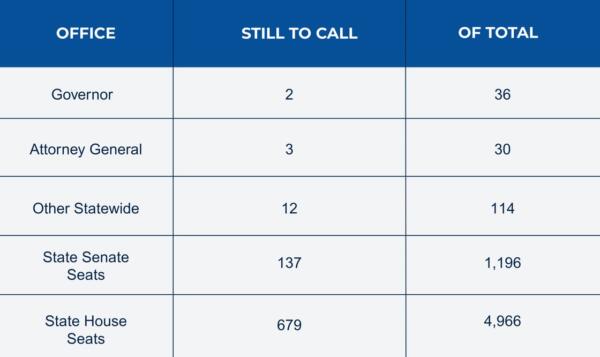
As with the federal results, the state picture remains incomplete, with a number of races still outstanding.
Races Still to Call
election 2
Governors
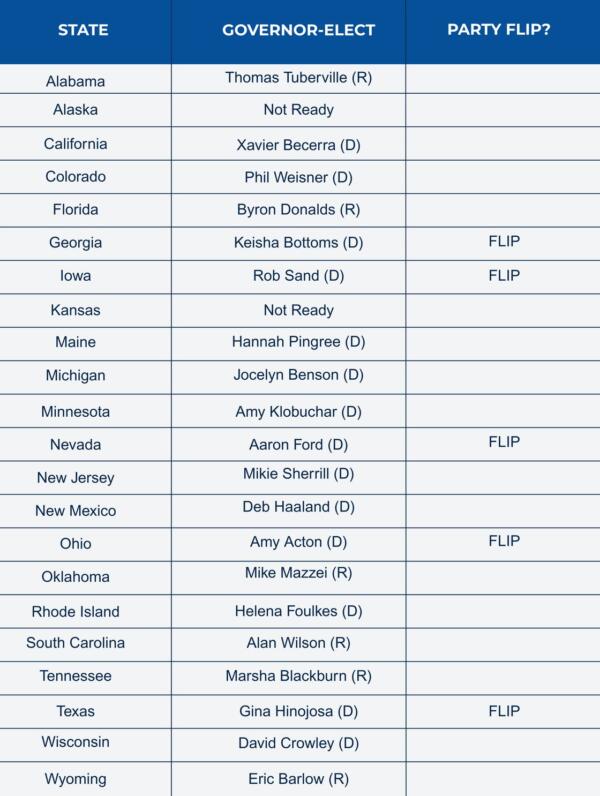
The governorships produced some of the most consequential shifts of the night, with five states flipping to Democratic control.
Five Governorships Flipped to Democratic Control: Georgia – Iowa – Nevada – Ohio – Texas
The full slate of newly elected governors, including those races not yet ready to call, is as follows.
election 3
Trifecta Status
A state government “trifecta” describes single-party government, when one political party holds the governorship and majorities in both chambers of the state legislature. Heading into the election, there were 23 Republican trifectas, 16 Democratic trifectas, and 11 divided governments. The 2026 results reshaped that balance, creating new Democratic trifectas and breaking up several Republican ones.
Four New Democratic Trifectas: Michigan – Minnesota – Nevada – Wisconsin
Five Trifecta Breakups: Georgia (was R) – Iowa (was R) – New Hampshire (was R) – Ohio (was R) – Texas (was R)
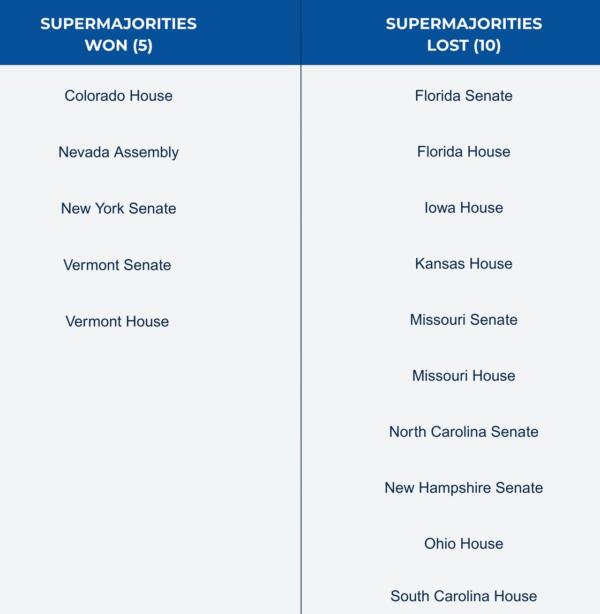
Legislative Supermajorities
Supermajorities also shifted meaningfully. A supermajority in a legislature means a vote threshold greater than a simple majority — more than 50 percent — and is usually required for decisions considered more consequential than passing ordinary legislation. Tracking where supermajorities were won and lost helps NACDS anticipate which states can move significant legislation without cross-party support.
election 4
NACDS State Priorities Moving Forward
The scale of this turnover — new governors, new majorities, and shifting supermajorities across dozens of states — represents a once-in-a-cycle opportunity to establish the pharmacy industry’s value proposition with a new generation of state policymakers.
Our strategic advantage will come from moving early: re-tiering states based on the new political landscape, engaging transition teams, educating newly elected officials before positions become entrenched, building bipartisan pharmacy champions, and connecting those relationships directly to our priorities around PBM reform, sustainable reimbursement, pharmacist-provided care, and pharmacy transformation.
As at the federal level, our issues in the states are, by and large, highly bipartisan, and the value of pharmacy-provided care is something leaders across the political spectrum can recognize and support. NACDS will work with member companies to prioritize engagement in the states where the turnover is greatest and the opportunity is clearest.
Election Day is not the end of an advocacy cycle. It is the beginning of the 2027 advocacy cycle.
CONCLUSION AND NEXT STEPS
Taken together, the federal and state results create a dramatically different political environment, but the bipartisan foundation supporting NACDS’ priorities remains strong at both levels. At the federal level, our immediate focus is twofold: pursuing our priorities in the lame-duck session while beginning early engagement with the newly elected members of Congress and their staffs. At the state level, our immediate focus is early engagement with incoming governors, legislative leaders, and newly elected officials ahead of the 2027 cycle.
NACDS will continue keeping member companies informed as Congressional leadership, committee assignments, the year-end legislative agenda, and state-level leadership and committee structures take shape. We welcome the engagement of member companies, Washington representatives, state advocacy teams, and NACDS RxIMPACT advocates as we translate this changed landscape into advances for pharmacy and the patients we serve.